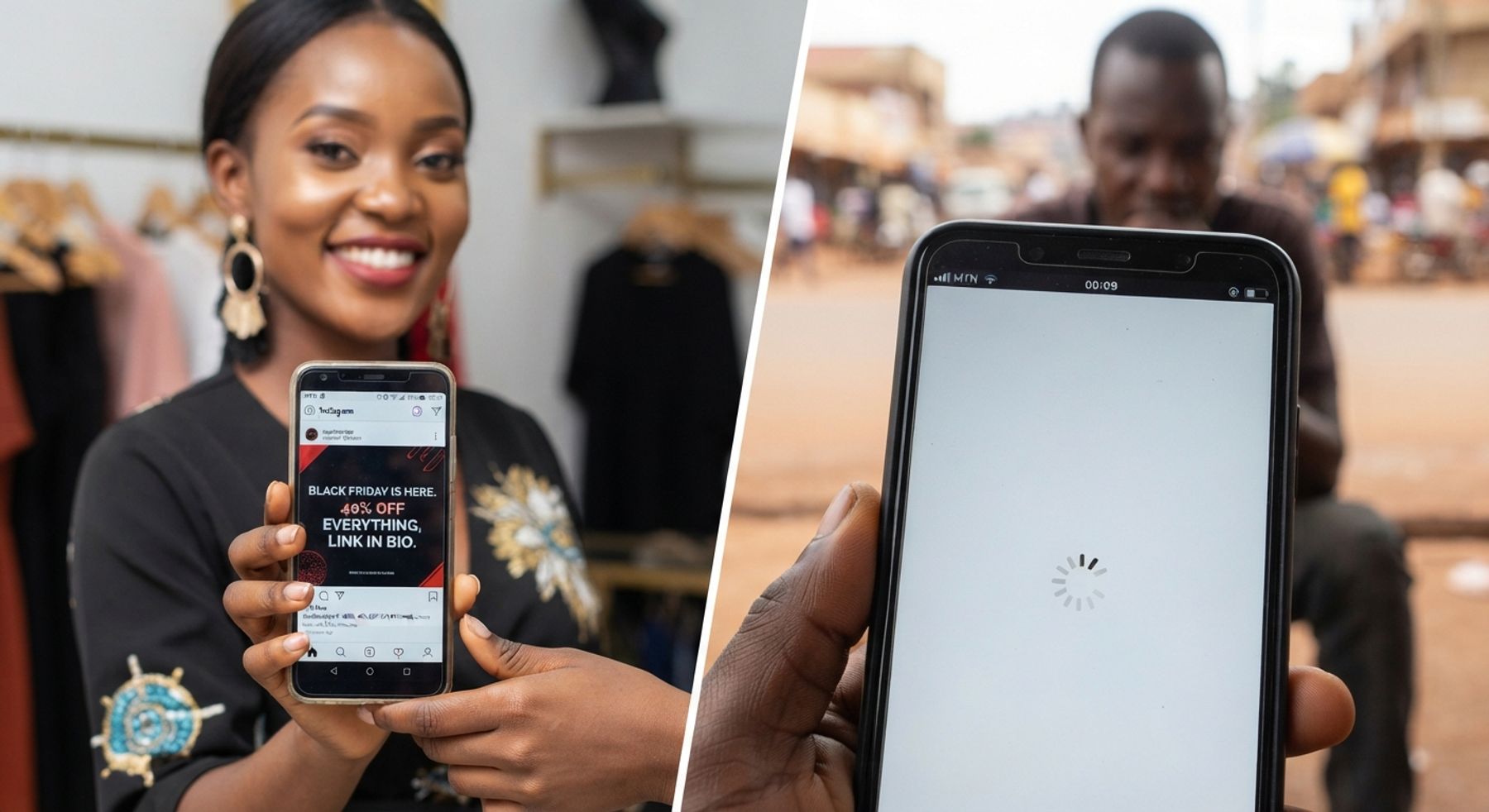
A boutique owner in Ntinda posts on Instagram at 7 a.m.: "Black Friday is here. 40% off everything, link in bio." Within the hour, two hundred people click through.
Her shop's Wi-Fi is fine. The problem is three towns away, on a shared hosting account nobody has touched since 2021, serving a homepage that takes nine seconds to load on a mid-range Android phone over an MTN data bundle.
Most of those two hundred people never see the discount. They see a spinner. Then they go back to Instagram.
This isn't a worst-case scenario I'm inventing. It's a Tuesday in late November, every year, for a large share of Ugandan businesses who try to ride Black Friday without anyone checking whether the thing the ad points to actually works.
Jumia doesn't need you to win. It just needs you to show up prepared
Black Friday in Uganda is, at this point, mostly a Jumia production, and a serious one. Last year's edition launched October 31, 2025, at Jumia's fulfilment centre in Kampala, ran through December 1, and leaned on partners including Airtel Money, Centenary Bank, Hisense, Redmi and Spiro.
Steven Lamony, Managing Director of Jumia Uganda, called it "one of our most important moments of the year, not just for sales, but for connection." Nyombi Thembo, Executive Director of the Uganda Communications Commission, went further, describing Uganda's e-commerce journey as "a testament to the power of innovation and inclusion."
Both are right, and worth taking seriously rather than dismissing as launch-day flattery. Jumia's logistics network, its JForce agent programme and its payment partnerships have genuinely pulled more Ugandans into buying things online than any single SME could on its own marketing budget. Credit where it's due.
But none of that infrastructure belongs to the boutique in Ntinda, or the electronics shop in Ndeeba, or the mattress business advertising on TikTok. It belongs to Jumia. Every other business running its own Black Friday promotion this November is renting the moment, not the machinery.
The real competitor on Black Friday isn't Jumia. It's your own homepage
Here is the part most small business owners get backwards. They treat the discount as the hard part and the website as the easy part, the thing a nephew set up once and nobody has opened since.
It's the opposite.
The discount is one sentence and a graphic. The website is the only thing standing between "someone saw the ad" and "someone paid." If it fails, the marketing spend didn't underperform. It worked exactly as intended, and then handed the sale to a competitor with a faster page, or to nobody at all.
A locked shop with the best discount in Kampala still loses the customer standing outside it. A website that doesn't load by the time a bored thumb swipes away is that same locked door, just digital.
What actually breaks, and what to fix before the rush
- Speed, measured on a real phone, on real data. Not your office Wi-Fi, not your laptop. Most Ugandan shoppers are on mid-range Android devices and metered data bundles. A homepage carrying five uncompressed product photos and an autoplaying video is asking a customer to spend their own shillings waiting for your sale to load. Test it on a 4G connection with the bundle half empty, which is closer to how most people will actually arrive.
- Make the buy button actually buy. A beautiful product page that ends in "DM us to order" isn't a store, it's a catalogue with extra steps. If checkout means waiting for someone to reply on WhatsApp during a traffic spike, you've built a queue, not a sale. At minimum, Mobile Money should work without a human in the loop.
- Don't make Instagram your checkout. A "link in bio" that drops shoppers onto a generic homepage, instead of the specific discounted product, loses most of them to confusion before they ever reach a price. Every ad should land on the exact page it promised.
- Plan for the spike, not the average Tuesday. A site that copes fine with twenty visitors a day can fall over at two hundred in an hour, especially on cheap shared hosting. If Black Friday is the one day you're actually trying to convert strangers into customers, it's also the one day your infrastructure gets tested hardest, by design.
None of this requires matching Jumia's scale. It requires making sure the three or four things a stranger actually does on your site, in this exact order (see the offer, trust the page, pay without friction, get a confirmation) all work under real conditions before you spend a single shilling driving traffic to them.
Discounts move customers toward your door. Whether any of them actually get inside is an infrastructure decision, made weeks before the ad ever runs.