Uganda's Newest Marketplace Doesn't Have an App. That's the Point.
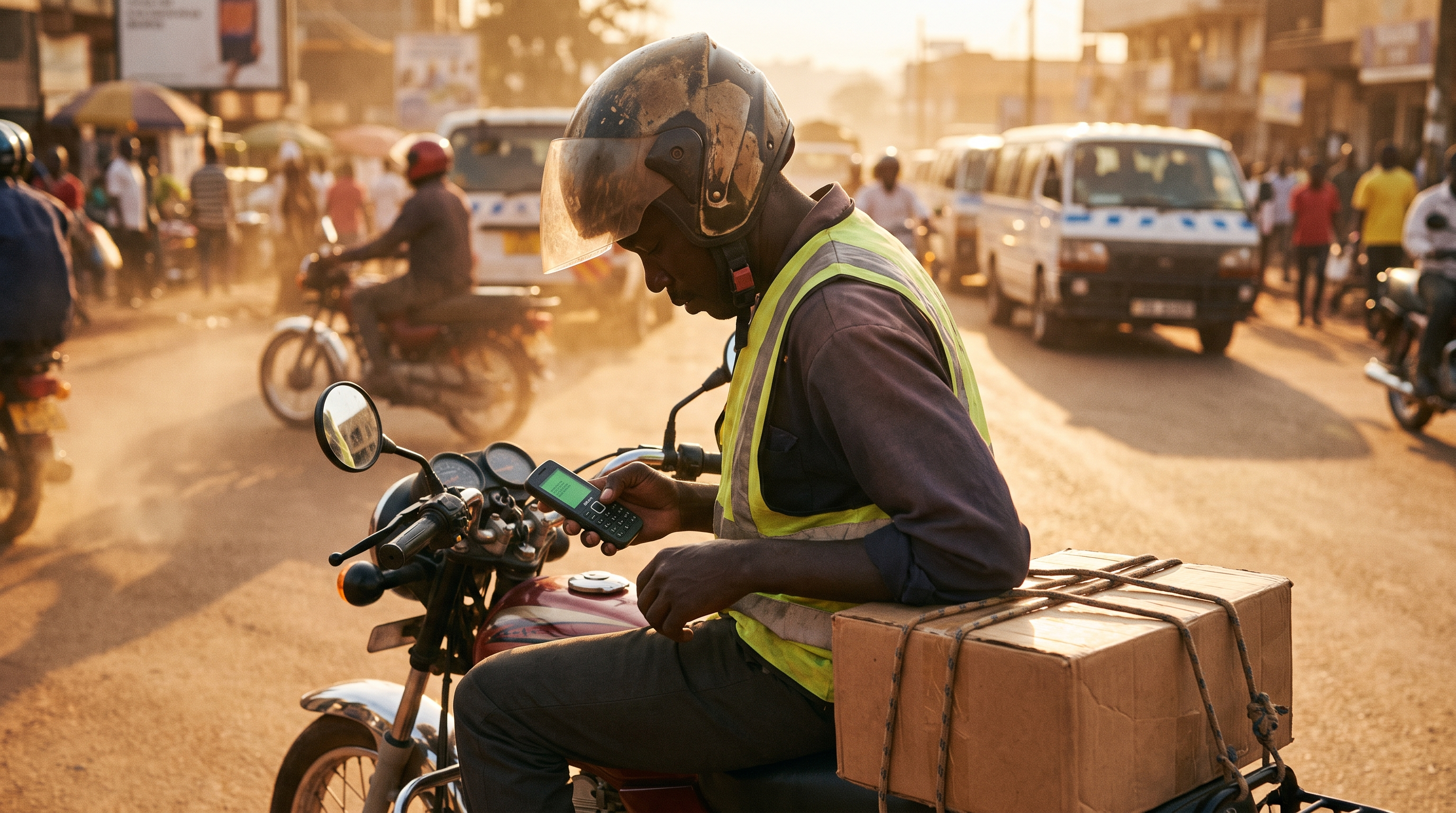
At a boda stage in Kampala, the wait used to go one way: riders parked, engines off, scrolling their phones until a passenger showed up. Some days that wait paid. Most days it didn't.
Frank Mawejje, chairman of the Boda Union, said it plainly at the Union Transport Alliance's product launch at Hotel Africana:
These things of sitting on the stage to wait for consumers to come will be over.
He wasn't talking about an app. He was talking about a USSD code.
Union Online Duuka — built by the Union Transport Alliance with fintech partner RukaPay, and expanded through a follow-up partnership with the United Informal Sector Forum on September 5 — turns Uganda's riders, taxi operators and truck drivers into a delivery network for an online marketplace. Customers browse products, take out school-fees or stockist loans through a facility riders call "Wetaase," and get it all delivered, without ever opening an app or a browser.
They dial *289*8*9#. That's it. No download. No data bundle. No smartphone required.
UTA chief executive Fred Ssenoga Bagenda told the launch crowd, under the campaign banner "Sowola — Shop & Chill":
This day is going to transform our lives.
It's the kind of line every product launch says about itself. Usually it's marketing. This time, the maths backs him up.
The market everyone's app forgot
Here's the number that should worry every business in Uganda building a slick app right now: 26.7 million feature phone subscriptions, against 18.2 million smartphones, according to the Uganda Communications Commission's own 2024 annual report. Smartphone penetration sits at 35.6% — behind Kenya's 72.6%, behind Ghana's 60%. A smartphone still costs 200,000 to 500,000 shillings before a 35% import tax lands on top; a feature phone costs a fraction of that and runs for days on a single charge in places where only a quarter of homes have reliable grid power.
Do the arithmetic and it's not close. Nearly two out of every three phones connected to a Ugandan network cannot open your beautifully designed app.
RukaPay clearly did that arithmetic before it did anything else. Its own core product runs on *289#, a code that works identically on a 2010 Nokia and a brand-new Android — and the company is rolling it out in deliberate phases, Kampala first, regional towns next, national coverage after that, rather than promising the whole country on day one and delivering Kampala.
That's not a lack of ambition. That's knowing exactly who you're building for before you build.
Building a shop nobody can reach
Contrast that with how most Ugandan businesses still approach going digital: commission a website, commission an app, launch, and hope. It's the equivalent of opening a boutique on the fourth floor of a building with no working lift, in a city where most of your customers can't climb four flights.
The shop is real. The products are good. Nobody who needed them can get in the door.
We've made this point before about slow websites eating a customer's data bundle before the homepage even loads. Union Online Duuka is the same lesson from the opposite direction — not "make the website faster," but "ask whether a website is even the right door for this customer." For a huge share of Uganda, the right door is a USSD menu, a WhatsApp catalogue, or an SMS confirmation, not a native app competing for space on a 16GB phone.
That's an uncomfortable thing for an agency to say, because apps and full websites are genuinely good products and we build plenty of them. But good technology serves the market it's actually selling into. A gorgeous e-commerce app that only 35.6% of the country can open isn't ambitious. It's incomplete.
Credit where it's due, and where it isn't yet
To be fair to Union Online Duuka: launch-day energy is cheap, and execution is where these things actually get tested. Fred Ssenoga's "this day is going to transform our lives" line means nothing in six months if riders aren't actually picking up delivery jobs between passenger trips, and traders aren't actually seeing real orders instead of window-shopping calls. A USSD code is only as good as the fulfilment behind it, and Uganda has watched ambitious platforms launch loud and go quiet before.
But the underlying bet — meet 26.7 million people where their phone actually is, instead of where you wish it was — is the right one. It's the same bet RukaPay made with its own payment rails, and the same one every serious digital strategy in this market should be making before a single line of design gets approved.
Build for the phone in their hand, not the one you wish they had.
Make It Happen builds for the Uganda that actually exists — feature phones, patchy data and all. If your last project was designed for the phone you wish your customers had, that's worth a conversation — hello@makeithappen.ug.